A winter wedding guest dress is a heavy fabric with a lining, in a deep colour, at the length the dress code names, hemmed for the shoes you will wear longest that day. In our view velvet, heavy crepe and a wool blend suit December better than chiffon. The dress code sets the hem: floor length for black tie, the knee to mid calf for cocktail. Then opaque tights, a boot or heel the hem was checked against, and a coat that stops above the knee so the dress keeps its own line. Here is each decision in order, with the inches.
Fabric first: weight is warmth
Our rule for a winter guest dress is to choose the fabric before the colour or the cut. In our view weight does two jobs in January: it holds warmth against you, and it hangs instead of clinging after four hours of sitting.
Our rule for a winter guest dress is to choose the fabric before the colour or the cut.
Velvet is a woven fabric with a dense, even pile, which is what gives it that soft hand. Crepe is a silk, wool or synthetic fabric with a crisp, crimped surface. Satin is not a fibre but a weave, glossy on the face and dull on the back, and in our view it only earns a place in winter when it is lined. Wool blends hold structure through a season.
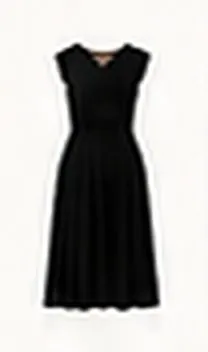
A lining matters as much as the face cloth. In our view it adds a second layer and lets the skirt move as one piece over tights. The Marlowe Midi Dress is the example in our range: heavy crepe, fully lined, with a defined waist and a fluid skirt. In our view the sheer and floaty fabrics are for June.

Colour in winter
In our view deep colour reads well in low light and against a winter room: black, bottle green, burgundy, navy, chocolate. Black is fine. Metallic belongs in an earring or a shoe rather than the whole dress.
The one rule is the one you already know. Zola's guest guide puts it plainly: "Don't wear white, cream, ivory, or any other shades of white (unless the couple has specifically asked guests to wear white)", and its black tie guide adds that white is "especially off limits at a black tie wedding". If you would call the colour white when asked, it is white.
What the dress code means in length
Each code names a hem position, so start there. For black tie, the Emily Post Institute's attire guide lists a "Formal (floor length) evening gown" first, then a "Dressy cocktail dress" or "Your dressiest little black dress". Zola's black tie guide draws the lower limit: "you shouldn't wear a dress that hits above your knee to a black tie wedding, as it's considered too casual", and it calls a midi "a bit more formal than a short cocktail dress". So black tie means floor length first, midi second, and nothing above the knee.
For black tie optional, Emily Post says "Women can choose either a formal evening gown, a shorter cocktail dress, or dressy separates." For cocktail or semi formal, Emily Post's bullet is "Short afternoon or cocktail dress", and Zola lists a cocktail dress, typically at the knee, a midi dress or a dressy jumpsuit. For casual, Zola lists a sundress, a midi dress or a jumpsuit. In a winter month, in our view, that means the midi.
Now the petite note. Wiktionary defines a midi as having its hemline at mid calf. The code is describing where the hem lands on you, not what the label says. In our view a dress sold as a midi that reaches your ankle has stopped being a midi on your body, and a cocktail hem cut for the knee may sit at mid calf. It is the point our wedding guest fit guide makes about the waist: "A midi is really a maxi if the waist sits in the wrong place."
Sleeves, or something over your arms
A long sleeve dress is the simplest answer to a cold church, and a sleeveless dress with a layer is the other. The Vela Open Back Midi is our long sleeve example: a soft shoulder, a covered front, a deep open back with a single strap across it, in heavy stretch crepe. Warm where you face the room, with the detail behind you. The front neckline decides the earring and the layer, and the necklines guide covers each one.
Our rule of thumb for a sleeve is the wrist bone. If the cuff covers your hand with your arms hanging, the sleeve was cut for a longer arm. Petite is the cut built for this: Wikipedia defines a petite size as one "designed specifically for women 163 cm (5 ft 4 in) and under", and Quince describes its petite patterns as "graded with shorter inseams, shorter sleeve lengths, and proportionally shifted waist, bust, and shoulder points". If you are buying regular, a long sleeve is the alteration to budget for. Our alteration tips say so directly: "Hems, sleeves and waistbands are simple and inexpensive to adjust. Shoulders, armholes and rises are not, so prioritise those when you shop." The shoulder seam has to sit on the bone when you buy. The cuff can be moved.
Where the hem lands in boots and heels
This is where winter changes the arithmetic, because the shoe changes between the car park and the dance floor. The hem does not move. The heel does. Take off a 3 inch heel and the hem drops 3 inches closer to the floor. Swap a 3 inch heel for a 2 inch boot heel and it drops 1 inch.
Our trouser rule applies to a floor length dress: "Half an inch of clearance keeps the hem clean." Hem a gown to clear the floor by half an inch in a 3 inch heel and it drags by 2.5 inches in a flat (0.5 minus 3) and by half an inch in a 2 inch boot heel (0.5 minus 1). Hem it for the flat and it clears the floor by 3.5 inches in the 3 inch heel (0.5 plus 3), which in our view reads as a long midi rather than a gown. What is wrong is hemming for a shoe you will wear for twenty minutes. Our recommendation: hem for the lowest shoe you will wear that day, or the one you will wear longest, and carry the other.
To check at home, put on the shoes you will actually wear, stand straight on a hard floor, and have someone measure from the hem to the floor at the front and at the back. For a midi, look for mid calf: not the ankle, and not the widest part of the calf. Our size guide gives an inseam for every size, 27 inches at XXS to 29.5 inches at XXL, a spread of 2.5 inches across the range, and in our view a fixed dress hem lands differently across that same range. The Marlowe's product page lists "Midi length, no alterations needed". Hold it against a dress you own and check where mid calf falls on you.

Tights, boots and the gap between them
In our view opaque tights make a winter midi work. Fogal's denier guide lays out the bands: sheer at 15 to 20 denier, semi opaque at 30 to 40, and opaque at 50 to 80, which it describes as "Smooth, even, covered and warmer." Our recommendation: for a church in December, opaque is the band for a midi, and for a floor length gown with a heel, sheer or nothing, because the hem is doing that work.
Then the boot. Our rule of thumb: a knee boot should meet the midi hem or sit just under it, so the line runs from hem to boot without a break at the widest point of the calf. It is the same point the trouser length guide makes about a cropped trouser: the one length to avoid is a stop at the widest part of the calf. Opaque tights in the colour of the boot turn any small gap into one continuous line. This is about the line, not about covering anything. If you wear heels indoors and boots outside, in our view the boot is the shoe to check the midi against, because it is the one you arrive in.
The coat over the dress
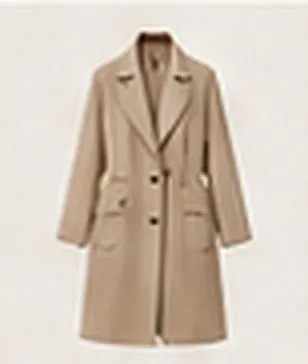
The coat is on for the car to the door and the photographs outside, so it gets the same length check. Our rule is that the coat and the dress should end in different places, with the dress hem clearly below the coat hem. The outerwear guide puts coat length at the knee or above the hip, and over a mid calf midi that is what keeps the dress as the line. The Lior Trench Coat is cut to do that: its product page says it "Hits just above the knee", double breasted, with a removable belt, in a cotton blend. In our view a cotton blend is the coat for a mild December and a short walk, with a knit under it for anything colder.
Indoors, if the venue is cold, a blazer is a better layer than keeping the coat on. The rule from our blazer edit is "A good blazer ends where your hip bone does." The Cato Tailored Blazer is cut to that rule: a single button at the natural waist, a higher armhole, fully lined, in a wool blend. For black tie, in our view a wrap or a stole in a heavy fabric does the same job without a second shoulder seam to fit.
Whichever layer you choose, check the shoulder first. The outerwear guide's test: "If the seam sits past your shoulder bone, try the size down even if the body feels snug."

What a tailor can fix before the date
A hem, a sleeve and a waistband. Not a shoulder, an armhole or a rise. That is our alterations page in one line. A regular dress with the right shoulder and a long hem is a quick fix, which is where our petite sizes guide ends up too. A dress with a shoulder seam sliding off the bone is not, however good the fabric.
Take the shoes with you, and the tights, since they change where the hem sits. Stand straight and ask the tailor to pin rather than guess. Ask the lead time when you book, and in our view buy the shoes before the fitting, because the shoe sets the hem.
The warmest thing you can wear to a winter wedding is a dress that ends where it was meant to.