In our reading, formal attire at a wedding calls for a long dress in a fabric with weight: floor length first, ankle length second, a long midi in crepe or satin third, or a tailored trouser suit. The hem is the rule, and the hem is set by the shoe you will stand in longest. Here is how that sits against the dress code guides, what not to wear, what a tailor can do to a gown, and the inches that change if you are 5 ft 4 in or under.
What formal attire means on an invitation
What does a wedding invitation that says formal attire mean? In our reading, one step below black tie. The Emily Post Institute's attire guide has no code headed formal. Its headings run Casual, Dressy Casual, Semi formal, Business Formal, Business Casual, Black Tie, Creative Black Tie, Black Tie Optional, Festive Attire and White Tie. In our reading, the nearest entry to a formal invitation is Black Tie Optional, where women choose from a "Formal (floor length) evening gown", a "Dressy cocktail dress", a little black dress or "Dressy separates", and men wear a tuxedo or a "Dark suit, white dress shirt, and conservative tie".
What does a wedding invitation that says formal attire mean? In our reading, one step below black tie.
What exactly is formal attire for a wedding? A long hem in a fabric that hangs, with the shine kept to one place. In our view the venue and the hour move it up or down. A ballroom at seven in the evening sits closer to black tie, so take the gown. A garden at four sits closer to cocktail, so the long midi does. Our reading of Emily Post's festive attire entry and its cocktail dress entries in hem length is in the holiday party guide.
What to wear when a wedding invite says formal attire? A floor length or ankle length dress in satin, crepe or velvet, or a tailored trouser suit, with one piece of jewellery and a shoe you can stand in for six hours. The lengths that pass, in order, are next.
The lengths that pass, in order
What should a female wedding guest wear for formal attire? Floor length first. Zola's black tie guide, by Jenn Sinrich and updated in March 2026, calls a dress that grazes the floor "a safe bet for any wedding invite that specifies black tie attire". Azazie's length guide, by Adela Shi in December 2025, says the safest and most widely accepted length for a classic black tie event is floor length. The gown is also the first entry under Emily Post's Black Tie Optional, so it passes everywhere.
Ankle length second. Azazie says ankle length dresses are now widely accepted at most black tie events. In our view an ankle length dress is as correct as the gown at a formal wedding and easier to walk in.
A long midi in a formal fabric third. Zola calls a tea length or midi dress a bit more formal than a short cocktail dress. Azazie's heading on tea length and midi says they are rarely accepted at black tie, though sometimes allowed. Formal is looser than black tie, and our rule is that a midi passes when it ends at mid calf or lower, in a fabric with weight, after dark. The floor of the whole code is Zola's line: "you shouldn't wear a dress that hits above your knee to a black tie wedding".
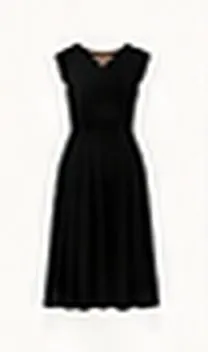
Can you give me an example of formal attire? Three, one at each length. A floor length black crepe gown hemmed half an inch off the floor in the shoe you will wear longest, one gold drop earring, a small bag. An ankle length satin dress with a covered front, a heel, nothing at the neck. Or the midi: the Marlowe Midi Dress, a square neck midi in a heavy crepe with a defined waist and a fluid skirt, fully lined. Check the waist before the hem. Our wedding guest dress guide puts it in one line: "A midi is really a maxi if the waist sits in the wrong place." The midi dresses are on dresses.

Fabric and colour, and what not to wear
What not to wear to a formal wedding as a guest? In our view, skip anything white, anything above the knee and anything in a daytime fabric. Zola's hem rule is written for black tie. Its white rule applies to every dress code. Zola's colour rule reads: "Generally, white is off limits to every wedding guest, no matter what the wedding dress code is". In our view that extends to ivory, cream and champagne, because the test is what you would call the colour if asked. In our view black passes, and our black dresses are gathered in the black dresses collection. Fabric is what makes a dress read as formal, in our view, more than the cut. Satin, crepe, velvet, heavy viscose, and lined. Not cotton, not thin jersey, not linen. In our experience, weight hangs when you stand up after two hours at a table, and thin fabric clings.
Then two rules of ours. Shine in one place: satin on the body, or gold at the ear, or a metallic shoe, never two. Skin in one place: an open back under a covered front, or a neckline with sleeves.
A trouser suit that reads as formal
Zola lists a pantsuit as an option besides a dress that can work for a black tie event, and in our reading, Emily Post's "Dressy separates" under Black Tie Optional leaves room for the same. So a trouser suit passes formal, provided the trouser is full length and the fabric has weight.
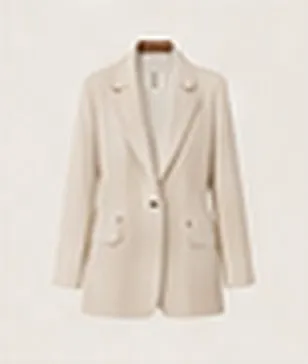
Ours is the Sena Wide Leg Trouser with the Cato Tailored Blazer. The Sena is high waisted with a pressed crease, a side zip and a hook and bar closure, in a viscose blend, with a 28 inch inseam in size S, cut to skim the floor in a flat shoe. The Cato is a single button blazer at the natural waist with a higher armhole, fully lined, in a wool blend, cut to end at the hip bone. That is the rule from our blazer edit: "A good blazer ends where your hip bone does." Under it, a satin camisole, or the blazer buttoned with nothing showing, so the shine or the skin stays in one place.
The inseam follows the shoe. Our trouser length guide says "Wide legs should skim the floor in the shoes you wear most", with half an inch of clearance. The Sena's 28 inches is cut for a flat. For a 3 inch heel, as an estimate, add the heel: 28 plus 3 is about 31 inches, the working our New Year's Eve guide uses for this trouser. Our size guide lists an inseam for every size, from 27 inches at XXS to 29.5 inches at XXL. Lay the trouser you own flat, measure from the crotch seam to the hem, and set it against the chart before ordering from bottoms.
If you are 5 ft 4 in or under: hem the gown for the shoe
Wikipedia defines a petite size as one "designed specifically for women 163 cm (5 ft 4 in) and under", and our petite sizes guide found petite grading runs about 2 inches shorter in the leg. Our rule of thumb is to expect the same order of difference on a gown, so a regular gown is about 2 inches too long before you put a shoe on, and the hem becomes the whole decision.
The rule is the trouser rule: "Half an inch of clearance keeps the hem clean." Now the working, and it is an estimate, since a heel lifts a hem that hangs from the waist by close to its own height. Hem the gown to clear the floor by half an inch in a 3 inch heel, and in flats it drags by 2.5 inches: 0.5 minus 3. In a 1.5 inch block heel it drags by 1 inch: 0.5 minus 1.5. Hem it for the flat instead, and in the 3 inch heel it clears the floor by 3.5 inches: 0.5 plus 3. That lifts the hem to about ankle height, by our estimate, which Azazie says is now widely accepted at most black tie events.
So the petite answer has three parts. Our recommendation is to hem for the lowest shoe you will wear longest. If that is a flat, the gown becomes an ankle length dress in the heel and still passes formal. If you will wear one heel all night, hem for it and carry nothing else. Azazie's advice for flats is the same: ankle length, or a floor length hemmed precisely. The same sums in boots are in our winter wedding guide.
To check at home, stand on a hard floor in the shoes and have someone measure from the hem to the floor at the front and at the back. Half an inch at the back, in the shoe you will wear longest, is the number.
What a tailor can and cannot do to a gown
Our alteration tips say it in two sentences: "Hems, sleeves and waistbands are simple and inexpensive to adjust. Shoulders, armholes and rises are not, so prioritise those when you shop." On a gown that means buy for the shoulder seam and the bust, and pay for the hem. In our view a tailor can take fabric away but not add it, so a gown that is short stays short, and a gown that is long is a quick fix.
A gown with several layers costs more to hem than one without. Jovani's alterations guide, by Julie DuRocher in November 2025, says gowns that are heavily beaded or have several layers run higher. Our advice: ask the tailor to quote with the lining and any tulle counted, not the face fabric alone, so the price does not change at the second fitting.
Timing, from the same guide: "Book your first fitting four to six weeks before prom and plan on one or two fittings, with a third only if the gown is complex." A wedding is no different. And: "Bring the exact shoes you plan to wear to your first fitting." Our addition is to bring the flat as well as the heel, and to decide which one the hem is for before the pins go in.

How short a midi may go on a shorter frame
In our view a midi ends at mid calf: not at the ankle, and not at the widest part of the calf. Our petite sizes guide puts the inseam grading difference at about 2 inches, and our rule of thumb is to expect the same order of difference on a dress hem, so a regular midi cut to mid calf on the fit model lands about 2 inches lower on a frame 5 ft 4 in or under, nearer the ankle. For a formal wedding that is no bad thing. An ankle length dress passes.
What a hem cannot fix is the waist. The petite sizes guide's line is "Take the hem up on a regular dress and only the hem moves." On a shorter frame, a regular midi's waist seam can sit below your waist, whatever the hem does. So the order is waist first, in the wedding shoes: the seam at your narrowest point. Then the hem: mid calf or lower, and if it reaches the ankle, call it an ankle length dress and wear it as one. Our rule of thumb for the top limit is mid calf, because after dark anything above it reads as cocktail. The Marlowe's product page lists "Midi length, no alterations needed". Hold it against a midi you own and see where mid calf falls on you.
A formal wedding asks one thing of a hem: that it clears the floor in the shoe you are actually standing in.