Your inseam is the length of the inside leg, from the crotch seam to the bottom of the hem. In our view the quickest way to measure it is from a pair of trousers you already own: lay them flat, fold them in half along the leg and run a tape from the crotch seam straight down the inside seam to the hem. To measure your body instead, stand barefoot against a wall, pull a hardback book up firmly between your legs, mark the wall at the top of the book and measure from the floor to the mark. The first number is the one to shop with. What it means for a straight, a wide and a cropped leg, and for a shorter leg, follows.
Measure a pair you already own
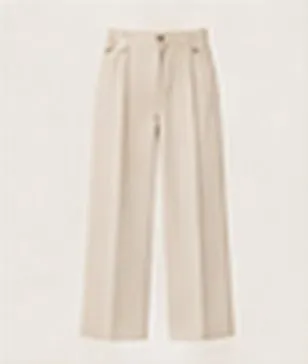
Pick the pair whose hem lands where you like it, in the shoes you wear with them. Key Apparel's measuring guide recommends trousers with no stretch for the most accurate measurement. Then, in order.
Pick the pair whose hem lands where you like it, in the shoes you wear with them.
- Lay the trousers flat on a table or the floor and smooth out every wrinkle.
- Fold them in half lengthwise so the two inside seams lie on top of each other.
- Find the crotch seam, the point where the front and back seams meet.
- Run the tape from that point straight down the inside seam to the bottom edge of the hem. Keep it on the seam, not across the fabric.
- Measure twice and write the number down to the nearest half inch.
That is a garment inseam, and it is the number every trouser on this site lists on its product page. Our size guide lists an inseam for every size, and each product page lists its own, so you can compare it with a pair you own.

Measure your body
A body inseam is useful when you own nothing that fits, or when you want to know how much leg a floor length trouser could ever use. Key Apparel's method is a tape run down the leg: stand barefoot against a wall with your feet about hip width apart, find the highest point of your inner thigh, and run the tape straight down the inside of the leg to the ankle bone, snug but not pulled tight. Our preferred version is less fiddly and does not depend on finding the right spot with a mirror.
- Stand barefoot with your back and heels against a wall, feet a few inches apart.
- Take a hardback book and pull its spine up firmly between your legs, flat against the wall, until it sits where a trouser's crotch seam would.
- Hold the book still, step away, and mark the wall at the top of its spine with a pencil.
- Measure from the floor to the mark. That is your inseam to the floor.
- Do it twice and take the average. Key Apparel's advice is the same: shifting your weight changes the number, so measure a couple of times.
In our view a second pair of hands makes the mark easier, but the book method works alone.
Why the two numbers differ
In our experience the body number will be longer than the garment number, because the hem stops short of the floor by whatever clearance the cut asks for. In our view that gap is the useful part: it tells you how much length you like to give up to your shoes and to the cut.
Shop with the garment number. A product page lists a garment inseam, the pair you measured has a garment inseam, and comparing like with like is the whole point of measuring. Keep the body number for one job: in our view it is the longest any trouser could be on you barefoot, so a listed inseam longer than it will pool on the floor unless you hem it.
What the number means for each cut
An inseam is only a number until you know where each cut is meant to stop. The landmarks below come from our trouser length guide and jean length guide, and each one can be measured on the pair you already own.
Straight leg
A straight leg looks sharpest when it grazes the top of your foot with no break. One soft fold across the front is fine. Two folds means they are long, and the line stops at your ankle instead of carrying through to the floor. To check it, put on the shoes you wear most, stand straight and look down: the hem should touch the shoe and nothing more.
Wide leg
A wide leg should skim the floor in the shoes you wear most, with about half an inch (1 cm) of clearance so the hem stays clean. Measure the gap between hem and floor while standing on a hard surface. In our view, more than an inch and the trouser reads as cropped by accident.
Cropped
A cropped leg works when it stops just above the ankle bone. Key Apparel puts the usual target at about 2 to 3 inches (5 to 8 cm) above it. The one length to avoid is the widest part of the calf, which shortens the leg and makes the crop look accidental rather than chosen. Mark the ankle bone on your leg, then measure up from it to the hem of the pair you are checking.
Heels, flats and the inch between
Measure in the shoes you will wear, and if you alternate between flats and heels, cut for the flats. A wide leg hemmed for flats takes a heel with a little extra break. In our experience a wide leg hemmed for heels drags in flats, and no shoe fixes that.
Key Apparel's rule for the other direction is to add an inch or two to your inseam if you usually wear boots with heels, and it notes that bootcut and flare styles need extra length to drape properly over shoes. In our view a straight leg is the most forgiving cut here. A floor skimming wide leg is the least forgiving, which is why we cut ours for a flat shoe and say so on the product page.
What your height says, and what it doesn't
Height is a rough guide to inseam and nothing more. Key Apparel's women's bands are: under 5 ft 4 in (163 cm), usually 26 to 28 inches for cropped styles and 29 to 30 for regular; 5 ft 4 in to 5 ft 7 in (163 to 170 cm), 29 to 31 inches for most styles; 5 ft 8 in (173 cm) and over, 32 to 36 inches. Mavi's denim guide points a more petite frame to 28 or 30 inch inseam jeans, and puts a straight leg that strikes above the ankle anywhere from 27 inches up to 34, depending on height.
What is my inseam size if I'm 5'2"? In Key Apparel's bands you are under 5 ft 4 in, which puts a full length trouser at 29 to 30 inches and a cropped one at 26 to 28. Our own size chart runs from 27 inches at XXS to 29.5 at XXL for a full length leg. In our view the bands are where you start, not where you stop: measure the pair you own and trust that number over the chart.
Is a 30 inch inseam long or short? Both, depending on who wears it. Key Apparel puts regular jeans at 30 to 32 inches, so a 30 inch (76 cm) inseam is the short end of a regular length. On a woman under 5 ft 4 in it is a full length trouser. At 5 ft 8 in it is 2 inches under Key Apparel's tall band, which starts at 32.
What height is a 32 inch inseam? In Key Apparel's bands a 32 inch (81 cm) inseam opens the tall band, 5 ft 8 in and over, which runs 32 to 36 inches. In our view a woman of 5 ft 7 in who wears heels or a floor skimming wide leg can use it too.
Is a 32 inseam long for 5'7"? By Key Apparel's bands, yes, by about an inch: 5 ft 4 in to 5 ft 7 in sits at 29 to 31 inches. In our view a hem takes the extra inch away.
Is a 30 inseam good for 5'8"? For a full length trouser, Key Apparel's tall band starts at 32 inches, so a 30 inch inseam at 5 ft 8 in is 2 inches under it and will sit higher on the ankle than a tall cut.
Two women of the same height can carry their length in different places, which is why we would rather you measure than estimate.
If you are petite: what the number does for you
Petite sizes are cut for women 5 ft 4 in (163 cm) and under, by Wikipedia's definition, and the cut changes the leg: Wintergreen Northern Wear's sizing chart describes its petite sizes as cut 2 inches (5 cm) shorter in the body and the trouser length, and NYDJ's size guide notes that its petite jeans also have shorter rises than regular and long. What petite changes garment by garment is in our petite sizes guide. Here it means one thing: regular trousers are cut for a longer leg, so the inseam is the first number to check.
We carry no P label. Our size guide lists an inseam for every size instead: 27 inches (69 cm) at XXS, 27.5 (70) at XS, 28 (71) at S, 28.5 (72) at M, 29 (74) at L and XL, and 29.5 (75) at XXL. Between neighbouring sizes the leg moves by half an inch or less, so in our experience the size that fits your waist and hip will also land close in length.
Each trouser gives its own inseam too. The Sena Wide Leg Trouser is 28 inches in size S, cut to skim the floor in a flat shoe. The Birk Straight Leg Jean is 27 inches in size S, with a high rise and a hem that grazes the top of your foot. Hold your garment number against those before ordering. The working is a subtraction. If your flat measured pair is 27.5 inches and the Sena is 28, the trouser arrives half an inch longer than your favourite. If that pair has half an inch of clearance, the Sena just reaches the floor, which a hem of half an inch would fix. If your pair is 26 and the Birk is 27, it arrives an inch long, which is a hem. If the rise sits wrong on you, no inseam number saves it, and the answer is a different size or a return.
The reason to do this sum before ordering is the same reason to measure at all. A regular trouser hemmed down to 27 inches still has its rise cut for a longer leg, and in our view the knee goes with it. In our view a trouser cut to 27 inches starts from the right proportions. Every pair on bottoms lists its inseam so you can tell the two apart from the screen.
Hem, cuff or return
The tailor's rule, from our alteration tips: hems, sleeves and waistbands are simple and inexpensive to adjust, and shoulders, armholes and rises are not. For trousers that leaves three outcomes.
A hem, when the length is wrong and everything else is right. If you love the original edge, ask for an inseam hem, where the tailor removes length above the cuff and reattaches the original hem. Key Apparel says most tailors can take 2 to 3 inches off while keeping the original hem style intact. Take the shoes you will wear and ask them to pin, not guess.
A cuff, when you want the trousers today. One deliberate turn on a straight or wide leg buys you the afternoon, and tells you whether the shorter length is worth paying for.
A return, when the rise is wrong, the knee sits low, or the hem would need more than a few inches taken off. Our rule of thumb: within an inch of your number, hem it; a wrong rise, send it back, because the leg length was never the problem.
Know your inseam, and a hem becomes a decision rather than a surprise.